The Second Question: Helping Kids Put Words to the Weather Inside

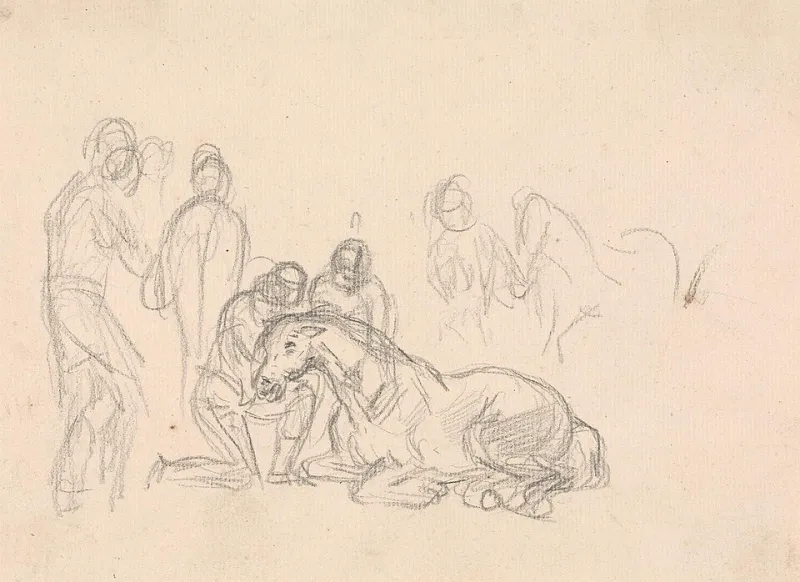
Photo: Masaccio, Public domain, via Wikimedia Commons
'Fine' is one of the most efficient words in a kid's vocabulary. It closes a conversation, satisfies the adult, and costs almost nothing. Sometimes fine is true. Sometimes it is a placeholder for 'I do not have the words yet.' And sometimes it is a small, cautious test: if I say fine, will you push, or will you stay nearby without making me perform?
At Loving Discipline Life, we talk a lot about calmer homes and kinder boundaries. This is one of those everyday moments where both meet. The follow-up to 'fine' does not have to be a cross-examination. It can be a second invitation, softer than the first.
Fine Is a Door, Not a Diagnosis
Kids often answer 'fine' because they are still learning to name what is happening inside them. Emotional literacy is not automatic. A child might feel a tangle of embarrassed, left out, tired, and mad, but only have access to the word 'fine' in the moment. Other times, they know exactly what is wrong and are not ready to hand it over. Both are normal.
If every 'fine' triggers twenty questions, kids learn that honesty requires a confession. If every 'fine' is accepted with total silence, kids may learn that no one is curious. The middle path is a low-pressure follow-up: one small question, then space. We are not trying to extract information. We are trying to make it safe to share it later.
Three Questions That Leave Room to Breathe
These work best when you are not staring directly at each other. Dinner, the car, and bedtime are all good because they come with built-in pauses. Use one question, not all three. And if the answer is a shrug, let the shrug be an answer for now.
1. 'If today had a weather report, what would it be?'
This one lands well at dinner because it is a little playful and does not require a feeling word right away. Foggy, windy, sunny with a chance of grumpy, partly cloudy. All are acceptable. Do not correct the forecast or rush to interpret it.
A simple response is enough: 'Foggy makes sense after a day like that.' Or, 'Windy. I know that feeling.' You are showing that the weather inside is welcome, not something to fix on the spot.
2. 'Was there a part of the day you wanted to fast-forward through?'
The car is a good setting for this because side-by-side conversation feels less like a spotlight. Fast-forward is easier than 'What happened?' and it gives a child a way to point at a moment without telling the whole story. You can also offer 'rewind' if they want to replay something good.
If they say 'lunch,' you do not need the full lunch report. Try, 'Lunch can be a lot. Want to tell me one thing about it, or leave it there for now?' That is a warm boundary around the conversation, not a demand for details.
3. 'Do you want words, company, or quiet right now?'
This is a bedtime question, or an after-school question, or a whenever-it-fits question. It gives the child some control over what happens next. Some kids need to talk. Some need you to sit on the edge of the bed and say nothing. Some need quiet and a later check-in.
If they choose quiet, honor it without a sigh. 'Quiet it is. I am around if that changes.' If they choose company, keep it low-key. You are not earning the right to ask more questions. You are just being with them.
When the Answer Is Still 'Fine'
Sometimes you will follow up gently and still get 'fine.' That is not a failure. Backing off is part of the work. It teaches kids that their no matters, which makes future yeses more trustworthy.
A few scripts that keep the door open without pushing:
- 'Okay. Thanks for checking in with yourself. I am around if fine turns into something else.'
- 'You do not have to have the right words tonight. I can sit here for a minute, no questions.'
- 'I hear you. If you want to talk later, I am not going anywhere.'
- 'That sounds like a lot. We can leave it there for now.'
Later, you can try one soft re-entry: 'Is now a better time to talk, or should I check back after dinner?' Notice the choice. Notice the exit. A child who knows they can decline is more likely to come back on their own.
The Point Is Not a Confession
The goal of the second question is not to prove that 'fine' was false. The goal is to build a habit: feelings can be named, questions can be gentle, and quiet can be respected. Some days your child will say 'fine' and mean it. Let that stand. Not every sigh is a crisis. Not every closed door is locked.
What you are offering is a little emotional vocabulary and a lot of safety. 'I am fine' can be true. The follow-up simply says, 'And if it is not, I am here for that, too.'