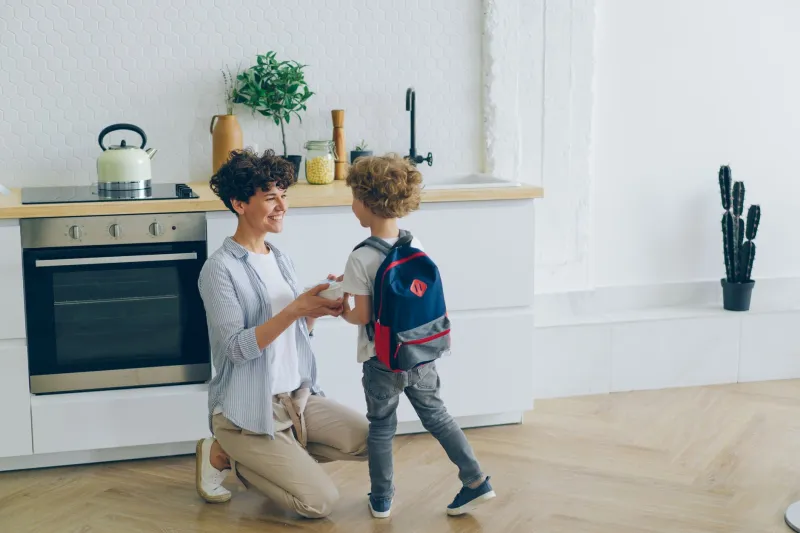
Five Minutes, Then the Door: A Bedtime Goodbye Kids Can Predict

It's 8:42 p.m. You have already done the teeth, the pajamas, the book, the song, the hug, and the second hug. And now, from the doorway, a small voice: one more thing.
If you're reading this, you already know the rest of the script. The water. The bathroom again. The question about a dinosaur fact that absolutely cannot wait until morning. The hug that becomes a grappling hold. Twenty minutes later you're sitting on the edge of the bed, whispering through your teeth, and nobody in the room feels calm — least of all the kid who was supposed to be asleep by 8:15.
Here's the reframe that changed things in our house: the "one more thing" loop usually isn't defiance. It's an ending that hasn't got a clear edge. Kids can't measure time, but they can absolutely read a goodbye. If yours keeps getting softer and more negotiable, they will keep reaching into it.
So the fix isn't a colder exit. It's a shorter, more predictable one — one your child can see coming from a mile away.
Why the Loop Keeps Restarting
Watch what actually happens during the requests. Each one buys another minute of you in the room, and another minute of not-yet-alone with the dark. That's not manipulation; that's a kid doing the only thing they know how to do with a wobbly feeling.
There's also a structural problem: bedtime is the one moment of the day when the adult is tired enough to answer differently every time. Some nights you're patient and give in. Some nights you snap. Either way, the request gets a fresh answer, and a fresh answer is an invitation to keep asking.
Predictability is the medicine here. Not coldness — predictability.
Build the Goodbye Before You Need It
Pick a short, fixed sequence and run it in the same order every single night. Ours is five minutes:
- One song, always the same one, sung badly at the door.
- One question — "What was the best part of today?" — asked from the hallway, not the bed.
- One hug, standing up.
- The line: "I love you. See you in the morning." Same words, every night.
- The door, closed to a two-inch crack.
Five steps, always in that order. Written on an index card taped inside the hall closet for the first two weeks, mostly so I would stop improvising. If your kid is old enough, let them help design it — a kid who picked the song is far less likely to spend twenty minutes trying to renegotiate it.
The other half of this is timing. Announce the countdown at ten minutes and again at five. "Five minutes and then the door." Kids who can't read a clock can absolutely read a countdown.
Words That Hold (And Don't Wobble)
The goal is warm and flat. Not sharp, not apologetic, not a debate. Say the same sentence in the same tone, even if you have to say it four times.
- "Water's finished for tonight. Your glass is right here for the morning."
- "We already had our hug. The next one is at 7:15 tomorrow."
- "I love you too much to keep negotiating."
- "I'm not going to answer that one. Goodnight, buddy."
- "I'll be right outside if you need me. The door stays like this."
Notice what's missing: explanations. Explanations are fuel. A tired kid does not need a paragraph about the importance of sleep; they need one boring, identical answer that means the conversation is closed but the relationship isn't.
Holding the Line While They Test It
Expect the testing. The first week of a new exit ritual often looks worse — more requests, more getting out of bed, sometimes tears. That's not evidence it's failing. That's a kid checking whether the new edge is real.
A few things that help:
Stand at the door, not on the bed. Physical distance makes the ending visible. Sitting back down is a reset button you don't want to press.
Walk them back without a lecture. If they appear in the hallway, take their hand, walk them back, tuck them in, say the same goodnight line, and leave. No speech about why they should stay in bed. Ten words maximum.
Separate reassurance from re-negotiation. "I'm right outside" is fine and can be repeated. Re-singing the song is not. Keep the comfort, drop the ritual restart.
Track your own consistency, not their speed. The metric for week one is "did I give the same answer every time," not "was my kid asleep by 8:20." The second one follows the first, just slower than you'd like.
Give the morning back. A warm reconnect at breakfast — five minutes, no agenda — takes the pressure off bedtime to carry the whole relationship. Kids negotiate hardest at the door when the door is the only place they get you.
When It's Something Bigger
Sometimes the loop isn't a habit. A new school year, a parent traveling, an illness, a scary headline overheard in the kitchen — all of those can push a kid to cling at lights-out. Meet the feeling without reopening the structure: a nightlight, a couple of extra minutes of sitting in silence, a sentence like "you seem worried tonight — tell me one thing before the door."
And if the distress goes on for weeks, wakes them repeatedly, or shows up alongside daytime worry, that's a good conversation to have with your pediatrician rather than a reason to abandon a bedtime routine that's otherwise working.
The Point Isn't a Quiet Hallway
The point is that your child learns endings can be short, warm, and something they can trust. You are not going cold. You're giving them the same five minutes, the same three sentences, the same crack of light in the door — every night, on purpose, until their body learns that the goodbye means sleep and the morning means you again.
That's not a power struggle with a winner. That's a rhythm. Go sing the song.