A Soft Place to Land, Not a Penalty Box: Building a Calm-Down Corner Kids Actually Choose
Somewhere along the way, the calm-down corner became a time-out with better branding.
You can spot the drift easily. The corner is used after an incident, not before one. An adult says the words "go to your calm-down corner" in a certain tone, and the child goes the way you go to the DMV — because there is no alternative and everyone involved knows it. The cushion is nice. The intention was good. But the message landing on the child is the same one a hundred years of punitive discipline has been sending: your big feelings are a problem, and you should go be a problem somewhere else.
A regulation space is a different animal, and the difference is not the beanbag. It's who's choosing.
The only rule that matters
The corner has to be available to a child who is not in trouble.
That's it. That's the whole test. If a child can walk over to the corner on a perfectly ordinary Tuesday afternoon — because they're bored, or overstimulated, or just feel like sitting in the tent for a while — then the corner is a regulation space. If it only ever appears as a consequence, it's furniture with a punishment attached, and no amount of soft lighting will change that.
Which means: never send a child there. Offer. Then respect the no.
"Your body seems like it needs a break. The corner's open if you want it. You can also just sit with me." Two choices, both allowed, no door in the conversation that closes behind them. Some kids will take the corner. Some will take you. Both are the point.
And here's a quiet detail that matters: don't make it a reward either. After a while, kids notice when the calm-down tent is suddenly rationed because "you lost it." Keep it neutral. It's a place. It's not a tally mark.
What actually goes in the basket
Keep it small, cheap, and durable, because it will be handled by someone whose nervous system is not currently cooperating.
For the body: a weighted lap pad, a firm squeeze ball, a body sock if your kid likes deep pressure, a small yoga ball for rolling. Weight and pressure settle some kids and absolutely do not work for others — find out during a calm moment, not a crisis.
For the mouth: a chewy, a crunchy snack, a straw. Mouth work is underrated for regulation, especially in younger kids.
For the ears: over-ear headphones or simple ear defenders. For a lot of children, noise is the whole problem, and one pair of muffs does more than eleven breathing exercises.
For the hands: paper to shred, a spiral notebook, putty, a pad of bubble wrap. Destructive-but-safe has more regulatory power than any fidget you'll buy.
For the eyes: a small timer, a feelings chart, a couple of picture books about big feelings. Visual anchors help kids who can't yet name what's happening.
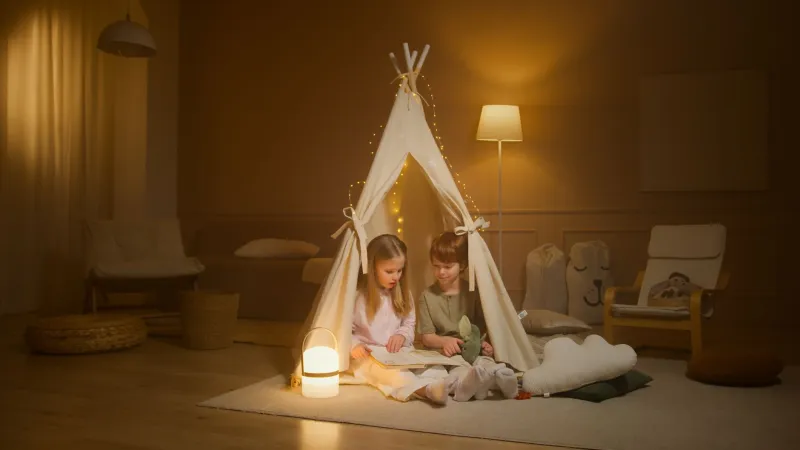
And somewhere to hide: the small tent or the canopy over the beanbag is not a gimmick. The visual barrier is the feature. A child who cannot see the room feels calmer than one who can.
What does not go in the basket: screens, homework, anything that has to be earned, anything you'd be annoyed about losing.
Teach it on a good day
A regulation space introduced mid-meltdown is just a time-out with a story attached. The teaching happens when everyone is fine.
Try this on a Saturday morning: sit down in the corner yourself. Let the child come find you and get curious. Show them three things — the headphones, the putty, the timer. Say, in plain language, "This is a place you can go when your body feels too full. Nobody will be in trouble here. You can come out whenever you want." Then demonstrate one tool. Squeeze the ball slowly. Put on the headphones for thirty seconds. Time the timer. Then leave.
That's it. One five-minute tour, repeated every couple of months, is enough. Kids learn by watching you use the corner more than by being talked to about it. So use it yourself. Sit in the beanbag with your coffee and say out loud, "I'm feeling frazzled, so I'm going to sit here for a few minutes." Nothing you say about regulation will be as persuasive as that.
Age by age, roughly
Toddlers and preschoolers need the corner in your sightline and a caregiver nearby, because co-regulation comes before self-regulation. The tent can be for the child; your body still needs to be within reach. Keep the basket to four items or it becomes a toy bin.
Elementary-age kids can handle a code word. Some families use a number — "I'm at a seven" — or a plain sentence. The word is useful because it lets a kid leave a room without having to explain themselves, which is exactly what they can't do in that moment.
Tweens and teens will often reject a cozy corner outright, and that's fine, because the concept just moves. The regulation space becomes their room, a walk around the block, a shower, headphones on the bus. Your job shifts from building the space to protecting it — which means not following them into it with a lecture.
Adults need one too, and it's not a self-care cliché. Your modeling is the curriculum.
If you've been using the corner as punishment
This is common and it's fixable, and the repair starts with you naming it plainly.
"Hey. I want to say something about the calm-down corner. I've been sending you there when you're in trouble, and that's not what it's for. It's supposed to be a place you choose. I got that wrong. I'm going to stop doing that."
That's the whole apology. Resist the urge to add a lesson to the end of it. No "because we're working on big feelings" — the explanation turns the apology back into a lecture.
Then change the mechanics, not just the words. For the next several weeks, do not use the corner as a consequence at all. If you need a limit, use a limit: "You can't hit. I'm going to move my body over here until things are safe." Boundaries can be warm and still do their job without borrowing the cushion.
Expect your child to test the new arrangement. They should. A kid who has only ever been sent to the corner will want to know if they're really allowed to go there voluntarily — and if they're really allowed to leave. Let them test it and prove it with your behavior, not your assurances.
The last piece of the repair is the one most of us skip: the conversation you have afterward. A regulation space doesn't cancel a repair. If your child used the corner to avoid apologizing to their brother, the corner still worked as a place to get steady, and the apology still has to happen once they're steady. Those two facts sit comfortably together.
A calm-down corner done well is a small, unremarkable thing in the corner of a room. You'll know it's working when you find your kid in there on a Saturday with a book and no reason at all.